Nursing Students Put Population Health into Action Across Rochester
This fall, students enrolled in NURS 301: Population Health & Wellness I are extending their learning far beyond the Fisher classroom. Led by Joy Hogan, visiting assistant professor, and Dr. Liz Dollinger, visiting instructor, the course integrates community-engaged learning with hands-on service, connecting nursing students to local organizations experiencing high volunteer demand.
The initiative aligns with Fisher’s commitment to experiential learning giving students the opportunity to understand community health challenges while contributing meaningful support to agencies across the Rochester region.
“Our nursing students are entering a profession rooted in service,” Hogan explained. “By volunteering with community partners, they begin to see firsthand the barriers many individuals face, whether it’s food insecurity, access to preventative care, or support for chronic conditions. These experiences allow students to apply course concepts while strengthening their sense of purpose as future nurses.”
To fulfill the course requirement of at least eight volunteer hours, students choose from opportunities across the region supporting organizations such as Foodlink, St. Peter’s Kitchen, Trillium Health, Wayne County Schools’ Get Ready to Grow Program, HCR HomeCare, the Upstate Fall Classic’s Special Olympics Healthy Athlete Event, and Mt. Hope Family Center.
For nursing major Christopher Johnston ’27, the project offered a powerful introduction to community-based care. “Over the course of this semester I have worked closely with Professor Hogan, members of the programs, and my classmates to improve our understanding of what it means to engage in the community for the betterment of those who are part of it,” he said.
Johnston volunteered at both Trillium Health and the Special Olympics Upstate Fall Classic Healthy Athlete event, gaining exposure to populations he had not previously worked with.
At Trillium, Johnston assisted in the food pantry, preparing produce for community members who lack access to stable, nutritious food options. His work included sorting and preparing fruits and vegetables, assembling bags, and ensuring food was safe for distribution. “Seeing how carefully volunteers worked to provide healthy options made me think differently about the challenges people face in simply accessing nutritious food,” he explained.
A moment at Trillium made a lasting impression when a community member requested food before the pantry had officially opened. “The long-time volunteers spoke to staff members about the situation and were able to provide this person with one of the bags of food,” Johnston recalled. “It really spoke to how we should meet people where they’re at and understand the extenuating circumstances that make achieving a state of well-being so hard for so many members of the community.”
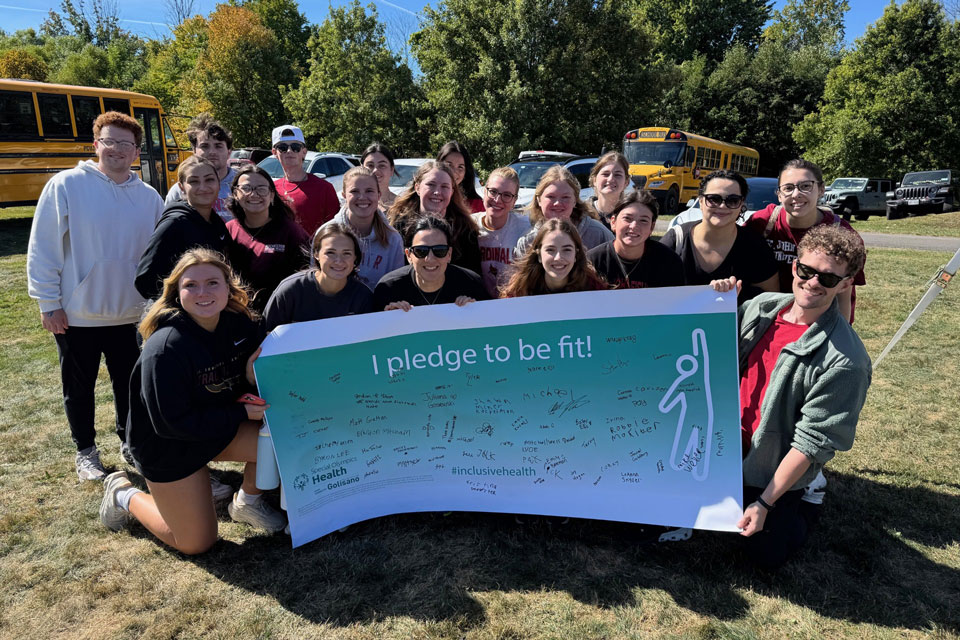
Johnston’s experience at the Special Olympics event was equally transformative. There, he helped staff wellness booths that taught athletes about healthy eating, goal setting, mindfulness, and physical activity. His station invited athletes to sign their names as a pledge to care for their bodies and well-being.
“Talking to the athletes at the Special Olympics inspired me and made me reflect on my long-held beliefs about working members of the community with intellectual or developmental disabilities,” Johnston said. “It really made me reevaluate how I perceive and treat members of the community with IDD.”
Throughout his volunteer experiences, Johnston found himself applying course concepts in meaningful ways. “Understanding the factors that affect different populations, and the community at large, helps us reevaluate our personal biases,” he explained. “It pushes us to look beyond what we see in front of us and consider the upstream factors that impact people. As future nurses, that perspective is essential.”
As the semester comes to an end, Hogan is inspired by how students are embracing the experience. “Watching students interact with community members, with kindness, respect, and genuine curiosity, shows us that they are not only becoming better nurses, but better humans,” she reflected. “They gain a broader view of our community, and the organizations we partner with feel energized by their enthusiasm. It’s meaningful on every level.”
Through reflection, research, and direct service, the course continues to model Fisher’s commitment to community-engaged learning. Students not only deepen their academic understanding of population health but also gain a powerful sense of empathy, advocacy, and professional purpose. For students like Johnston, it was an experience that embodies Fisher’s mission.
“The only difference between ideas of positive change and reality is your actions, so be a part of the positive change you want to see in your community,” he said.