Pharmacy Students Attend First Service Trip in Kenya
October 8, 2026
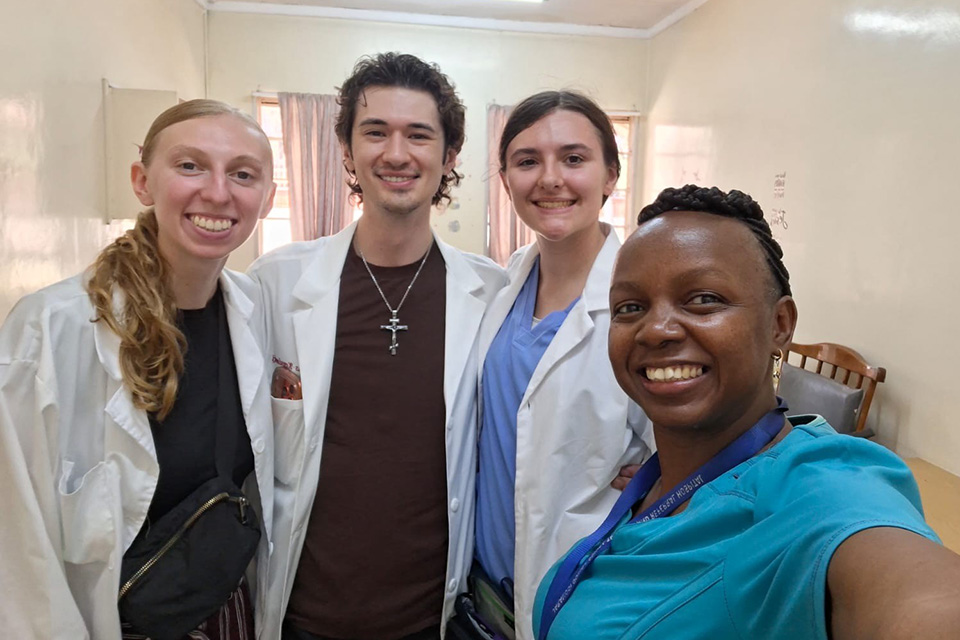
This summer, three students from the Wegmans School of Pharmacy joined Dr. Lisa Phillips, associate professor of pharmacy, in Kisumu, Kenya to visit Maseno University and Jaramogi Oginga Odinga Teaching & Referral Hospital (JOOTRH).
The trip offered the students engagement in multiple different settings, such as observing clinical rounds at Jaramogi Oginga Odinga Teaching and Referral Hospital (JOOTRH), with pediatrician Dy Joy Muyonga; working with the hospital phlebotomists from microbiology who are actively involved in research with Dr. Phillips; and collaborating alongside Kenyan pharmacy students as part of an academic teaching program. Additionally, the students served the children at the hospital by hosting a crafting day where the children made bracelets, drawings, and facemasks.
The partnership began in 2024 when Phillips was on a Fulbright Scholarship for a semester in Kenya. Following her Fulbright, Phillips worked with Fisher colleagues Dr. Juliette Miller, clinical assistant professor; Dr. Keith DelMonte, associate professor and director of experiential education and CPE; and Dr. Kelly Conn, associate professor of pharmacy practice and administration, as well as faculty from three other schools of pharmacy, including Samford University, University of Maryland Eastern Shore, and Midwestern University worked with Dean Maima from Maseno School of Pharmacy, Kenya, to develop a pharmacy preceptor program in Kenya. It was the first of its kind offered in Kenya and was approved by the Pharmacy and Poisons Board of Kenya for continuing education credit for Kenyan pharmacists.
The program consisted of a five-module home study that culminated at the live, hybrid training in Kisumu. What made this program unique was having Fisher pharmacy students Cassidy Pearce, Claire Rider, and Tom Kowalewski serve as standardized students in simulations. Similar to how standardized patients are actors trained to respond in certain ways as a patient, the standardized students were trained to respond in different ways depending on how the preceptor engaged with them, knowing how the preceptors were expected to respond and engage during training activities.
In addition to helping run the Pharmacy Preceptor Development Program, students spent time in clinical settings at JOOTHR.
Kowalewski worked with the phlebotomy team and pediatric doctors. Through shadowing on rounds, he learned how providers handle the extreme cases pediatric patients face, noting their problem-solving and decision-making process for the best course of care when go-to medications were unavailable.
“They did not just give up on the patient or send them home but rather brainstormed a new care plan for the patient based on what resources they had available,” he said. “As a pharmacist, I had the opportunity to be exposed to an entirely new demographic of patients who suffer from illnesses and diseases that I have never seen up close in the United States. This opportunity has allowed me to become more well rounded when it comes to different demographics of patients and for that I am extremely grateful.”
Simultaneously, Pearce rounded with doctors and shadowed microbiologists to see daily hospital practices, helping with ongoing quality improvement projects and hosting arts and crafts sessions for the patients and their siblings.
“The most impactful moment was when I watched the children's excitement in making bracelets and superhero masks,” she said. “The room was filled with excitement of the children, their mothers, and the healthcare providers who were all very thankful for us being there. I loved that we could help bring joy to the hospital, and this was my favorite part of the trip.”
Phillips said what made this trip particularly unique was the longevity of the relationships she built with her colleagues and the many people who befriended her while in Kenya, and that she has remained connected with them. Since completing her Fulbright, she has returned to Kenya three times and hopes to make 2-3 trips per year to continue working on initiatives that improve pharmaceutical care, patient outcomes, and pharmacy practice and education. These relationships made the trip more than a service mission; they offered students more personal engagement as they learned from their Kenyan pharmacy peers and interprofessional colleagues while building personal connections.
“I have a ‘family’ now in Kenya, so when the students come, they get to meet people and be welcomed professionally, personally, and culturally,” said Phillips. “This trip was diverse in experience, where students were in the clinical setting, observed hospital practices, engaged with Kenyan pharmacy students, taught Kenyan pharmacy preceptors, and got to travel around Kenya to see the diversity in culture and landscape.”
Students also got to visit the Maasai Mara and meet the Maasai while on safari.
To students interested in participating in a medical service trip, Phillips encourages them to talk to students who have participated and ask.
“Ask. There’s never going to be an opportunity if you don’t ask. So, be curious and ask,” she said. “I really want students to think about engaging in an international service trip.”
Looking ahead, Phillips plans to continue work with Maseno University and JOOTRH and hopes this will lead to a true bidirectional cultural exchange program that brings students and pharmacists from Kenya to observe how pharmacists practice in the United States.
Pharmacy Students Attend First Service Trip in Kenya2026-10-08T12:26:23-04:00This summer, three students from the Wegmans School of Pharmacy joined Dr. Lisa Phillips, associate professor of pharmacy, in Kisumu, Kenya to visit Maseno University and Jaramogi Oginga Odinga Teaching & Referral Hospital (JOOTRH).The trip offered the students engagement in multiple different settings, such as observing clinical rounds at Jaramogi Oginga Odinga Teaching and Referral Hospital (JOOTRH), with pediatrician Dy Joy Muyonga; working with the hospital phlebotomists from microbiology who are actively involved in research with Dr. Phillips; and collaborating alongside Kenyan pharmacy students as part of an academic teaching program. Additionally, the students served the children at the hospital by hosting a crafting day where the children made bracelets, drawings, and facemasks.
The partnership began in 2024 when Phillips was on a Fulbright Scholarship for a semester in Kenya. Following her Fulbright, Phillips worked with Fisher colleagues Dr. Juliette Miller, clinical assistant professor; Dr. Keith DelMonte, associate professor and director of experiential education and CPE; and Dr. Kelly Conn, associate professor of pharmacy practice and administration, as well as faculty from three other schools of pharmacy, including Samford University, University of Maryland Eastern Shore, and Midwestern University worked with Dean Maima from Maseno School of Pharmacy, Kenya, to develop a pharmacy preceptor program in Kenya. It was the first of its kind offered in Kenya and was approved by the Pharmacy and Poisons Board of Kenya for continuing education credit for Kenyan pharmacists.
The program consisted of a five-module home study that culminated at the live, hybrid training in Kisumu. What made this program unique was having Fisher pharmacy students Cassidy Pearce, Claire Rider, and Tom Kowalewski serve as standardized students in simulations. Similar to how standardized patients are actors trained to respond in certain ways as a patient, the standardized students were trained to respond in different ways depending on how the preceptor engaged with them, knowing how the preceptors were expected to respond and engage during training activities.
In addition to helping run the Pharmacy Preceptor Development Program, students spent time in clinical settings at JOOTHR.
Kowalewski worked with the phlebotomy team and pediatric doctors. Through shadowing on rounds, he learned how providers handle the extreme cases pediatric patients face, noting their problem-solving and decision-making process for the best course of care when go-to medications were unavailable.
“They did not just give up on the patient or send them home but rather brainstormed a new care plan for the patient based on what resources they had available,” he said. “As a pharmacist, I had the opportunity to be exposed to an entirely new demographic of patients who suffer from illnesses and diseases that I have never seen up close in the United States. This opportunity has allowed me to become more well rounded when it comes to different demographics of patients and for that I am extremely grateful.”
Simultaneously, Pearce rounded with doctors and shadowed microbiologists to see daily hospital practices, helping with ongoing quality improvement projects and hosting arts and crafts sessions for the patients and their siblings.
“The most impactful moment was when I watched the children's excitement in making bracelets and superhero masks,” she said. “The room was filled with excitement of the children, their mothers, and the healthcare providers who were all very thankful for us being there. I loved that we could help bring joy to the hospital, and this was my favorite part of the trip.”
Phillips said what made this trip particularly unique was the longevity of the relationships she built with her colleagues and the many people who befriended her while in Kenya, and that she has remained connected with them. Since completing her Fulbright, she has returned to Kenya three times and hopes to make 2-3 trips per year to continue working on initiatives that improve pharmaceutical care, patient outcomes, and pharmacy practice and education. These relationships made the trip more than a service mission; they offered students more personal engagement as they learned from their Kenyan pharmacy peers and interprofessional colleagues while building personal connections.
“I have a ‘family’ now in Kenya, so when the students come, they get to meet people and be welcomed professionally, personally, and culturally,” said Phillips. “This trip was diverse in experience, where students were in the clinical setting, observed hospital practices, engaged with Kenyan pharmacy students, taught Kenyan pharmacy preceptors, and got to travel around Kenya to see the diversity in culture and landscape.”
Students also got to visit the Maasai Mara and meet the Maasai while on safari.
To students interested in participating in a medical service trip, Phillips encourages them to talk to students who have participated and ask.
“Ask. There’s never going to be an opportunity if you don’t ask. So, be curious and ask,” she said. “I really want students to think about engaging in an international service trip.”
Looking ahead, Phillips plans to continue work with Maseno University and JOOTRH and hopes this will lead to a true bidirectional cultural exchange program that brings students and pharmacists from Kenya to observe how pharmacists practice in the United States./media/news-images/fall-2026/Kenya-2026_960.jpg