Fisher Grant Incubator Program Encourages Culture of Research and Scholarship
September 14, 2026
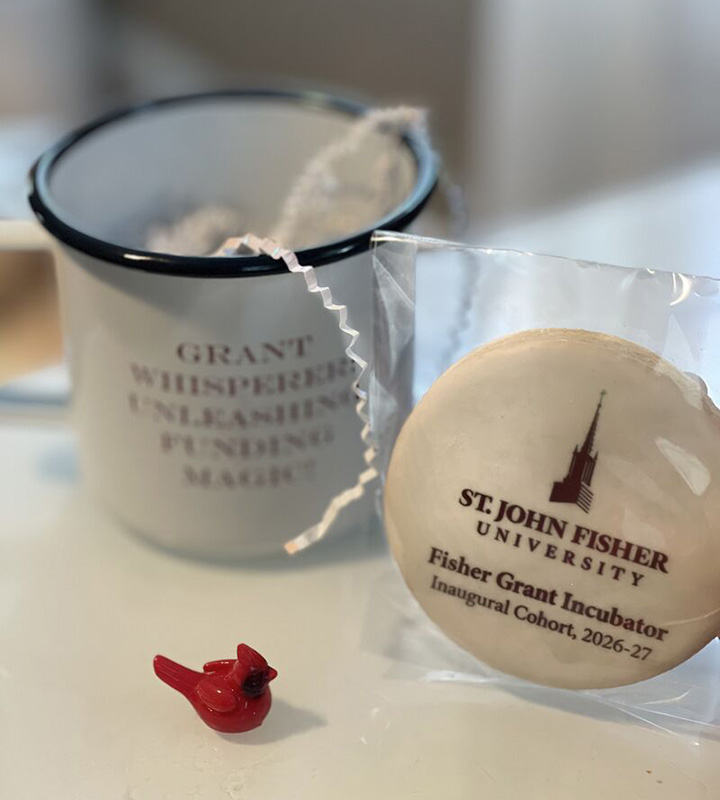
During the last academic year, St. John Fisher University reached a pivotal institutional milestone, officially recording $5 million in research expenditures under the latest FY25 HERD (Higher Education Research and Development) Survey. To build upon this momentum, the University launched the Fisher Grant Incubator Program in May 2026, a strategic transition toward a systemic, campus-wide culture of sustained research and scholarship.
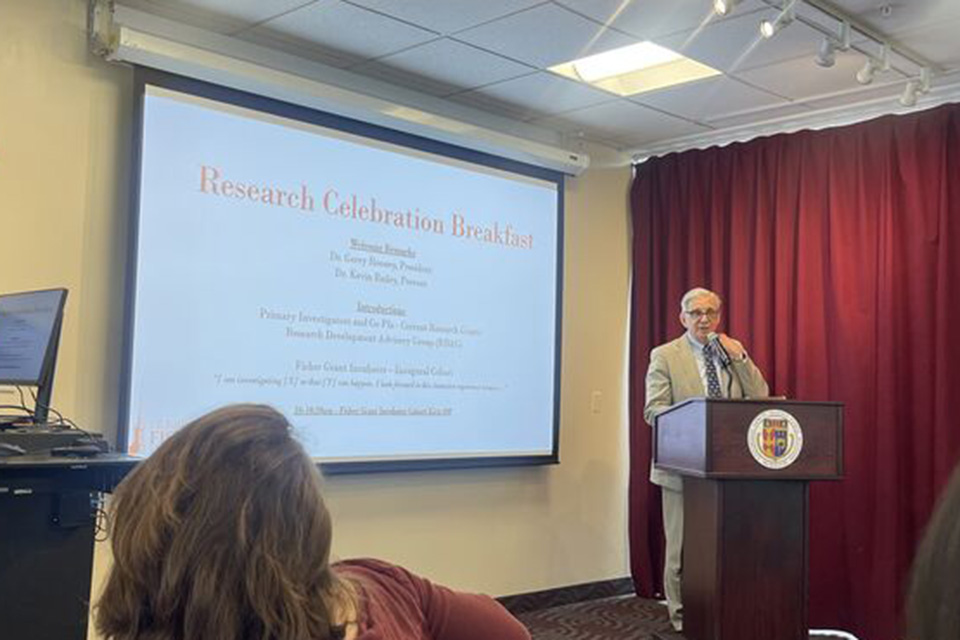
The year-long professional development program is spearheaded by the Office of Sponsored Programs (OSP) and is designed to support faculty who are in the early stages of their research trajectories or shifting their academic focus.
The goal is to guide faculty step-by-step from a “blank page” to a fully polished, submission-ready external grant proposal over 12 months. Faculty commit to a rigorous curriculum consisting of monthly cohort workshops, regular “homework” assignments, and two 60-minute one-on-one consultation sessions with the Office of Sponsored Programs. Participants who fulfill all session requirements and successfully submit an external grant proposal will earn a $1,000 stipend.
Faculty participants in the first cohort were selected via a competitive application process and include: Dr. Jonathan Millen, assistant professor of biology; Dr. Priyanka Bhatt, assistant professor of pharmaceutical sciences; Dr. Emma Greenspon, assistant professor of psychology; Dr. Yi Liu, assistant professor of finance; Dr. Ozge Kantas, assistant professor of psychology; Dr. Ankit Rochani, visiting assistant professor of pharmaceutical sciences; Dr. Mary Wines-Samuelson, visiting assistant professor of pharmaceutical sciences; Jinyan Chang, assistant professor of economics; Dr. Emily Kerr, assistant professor of chemistry; and Dr. Katie Ledwin, assistant professor of nursing.
“The incubator is explicitly linked to the Center for Student Research and Creative Work to maximize the engagement of students in research, which supports Fisher students gaining high-level, workforce-ready skills—such as data analysis, technical writing, teamwork, and professional communication—directly alongside their faculty mentors,” said Dr. Kristin Picardo, assistant provost and director of the Center.
In addition, the program curriculum embraces 2026 federal shifts by teaching faculty how to leverage ethical, AI-powered workflows. By participating, faculty will master utilizing AI tools for Request for Proposal (RFP) extraction and project alignment, deploying AI responsibly to synthesize literature and pinpoint critical research gaps, and navigating rigid data privacy rules that forbid uploading confidential or proprietary data to public AI platforms.
Picardo said that one core objective of the program is to integrate faculty scholarship with modern digital research infrastructure to ensure Fisher’s discoveries are visible globally. She added that the overarching goal is to cultivate a sustainable culture of sponsored research that advances collaborative faculty-student scholarship at Fisher.
Upon hearing about the program, Ledwin said that it stood out as an opportunity to further develop a project that was already emerging from her teaching and research interests in artificial intelligence, technology, and educational pedagogy. Her work is currently exploring how emerging technologies can be ethically and effectively incorporated into nursing curricula to prepare future nurses for an increasingly more digital healthcare environment.
“I am working on a research project that focuses on the integration of artificial intelligence into nursing education, specifically the use of an AI-derived chatbot to support student learning,” she said. “The project examines whether a customized, course-aligned chatbot can enhance student learning by supporting mastery of complex concepts, clinical reasoning, perceived competence, academic performance, and attitudes toward AI.”
Her plan is to incorporate both graduate and undergraduate students into the project to expose them to training on project development, data collection, analysis, and dissemination as research assistants. Her long-term goal is to develop a sustainable nursing research trajectory where students will be able to develop independent research projects under the supervision of doctoral-prepared nursing researchers. To date, Ledwin has written and submitted for a national grant with support from the Fisher Grant Incubator and OSP.
“The program has been valuable in helping move my project toward a more developed and outcomes-focused research initiative. It has also helped strengthen the project’s alignment with institutional priorities and has been a meaningful opportunity to advance a project that has direct relevance to teaching, learning, and the future of nursing education,” noted Ledwin.
Kerr’s research focuses on synthesizing and using electrochemistry to characterize new battery chemistries.
“It’s a fun project because it lets me work with students on a variety of different chemical subdisciplines, everything from making the molecules to designing the batteries and we get to collaborate with people in a lot of different fields, ranging from chemists to engineers,” she said.
Currently, Kerr has students working with her in the fall, three of whom worked with her during the summer months. One of the students is also co-publishing a paper with Kerr along with a collaborator, and she has applied to co-author a conference talk with the other student.
For her, the program has been useful for clarifying future goals for her research program. “Trying to condense possible future directions into a compelling page-long summary with specific aims was a good way to clarify exactly what I want to work on, how students will be involved, and how it’s going to benefit both the battery community and students.”
After just a year at Fisher, Wines-Samuelson has already benefited from several internal grants, but said that being part of the Fisher Grant Incubator Program has already been helpful in launching her research efforts. Her focus is on how sleep and the status of circadian rhythm impact neurodegenerative disease, and she aims to investigate whether sleep disruption is a key factor in the progression of diseases including Alzheimer’s or Parkinson’s dementia.
“Circadian rhythm disruption in humans is frequently associated with severe mood or behavioral disorders, and sleep is essential for proper long-term memory storage and learning,” she said. “On the flipside, I would like to test whether improved quality and duration of sleep could slow or even reverse some of the neuronal loss in these devastating diseases. Sleep is a highly-underrated pivotal factor for our health in so many aspects: metabolic balance, mood, memory, immune function, growth and hormonal signaling, reproductive health. Yet it is not receiving any attention as a powerful potential therapeutic.”
She has been in the process of setting up her lab and equipment. In the spring semester, three P2 students began working with her and she has an undergraduate student who may work in her lab during the fall semester.
Bhatt’s research focus is in the area of pharmaceutics and nanomedicine, specifically developing advanced novel drug delivery systems to treat ocular diseases, including neovascular age-related macular degeneration. She is actively mentoring Pharm.D. and undergraduate research students, giving them hands-on experience in literature review, nanoparticle formulation development, laboratory characterization techniques, in vitro cell culture techniques, presenting poster research at regional and national conferences, and writing scientific manuscripts.
“Through our ongoing work in formulation development and characterization, we have successfully developed and evaluated novel drug-loaded nanoparticle formulations,” she said. “We have been able to present our findings at academic showcases and national conferences, and we are continuously refining these systems for sustained therapeutic efficacy and their effectiveness in ocular cells.”
The ultimate goal of her research is to overcome physiological barriers in drug delivery to provide safer, more effective, and non-invasive or long-acting treatment options for chronic ocular diseases, improving patient compliance and therapeutic outcomes. She said the program has been beneficial to these goals.
“It provides structure, valuable feedback, and dedicated resources that help streamline grant proposal development, identify funding options, and foster interdisciplinary collaboration among faculty,” said Bhatt. “I am very grateful for the support provided by the University and the Office of Sponsored Programs. Bridging laboratory research with student learning and external funding opportunities is essential for advancing impactful healthcare solutions.”